
Talking about capitalism, structural violence, and ICE at the National Prayer Breakfast
(And, how nationalism and violence, touted by Trump and Hegseth, is not Jesus)

Whoa. What a weird experience to be in a room with Trump, Hegseth, Kristi Noem, Paula White, Pam Bondi and others. I’m not sure how to start this - but, the National Prayer Breakfast was weird, FULL of Christian Nationalism, and everything-opposite-of-Jesus. Where Trump and Hegseth openly mocked people in the room, mocked Minneapolis’ deaths, mocked immigrants - and people stood on their feet for it. Hegseth said that peace comes through power and strength (alluding to violence) - because the Bible said that’s the way peace comes. Wait, what? Not my Bible. That’s when I walked out of the room. It was all expected - and still awful and shocking. Scary, maddening, ruthless, reckless, unconscionable. I was the only one that I could see that wasn’t standing up. Even when Trump came in and you’re supposed to stand up for a President - I refused to stand. And got looks and loud claps while a lady glared. It’s a small act of resistance and I’m sure there were others in the room who stayed seated (although I couldn’t see them). But, I refused to stand up for people blatantly mocking people who died or immigrants or…all while usurping the words of Jesus for power and privilege - in the name of ‘religion’? “Woe to those who make unjust laws and oppress the poor…” Trump said that he is bringing religion back to the US and called for a national day of prayer in May to do so. That religion is one of war, hate, and power, though. It is certainly not Jesus.
After the rambling-anti-Jesus talks that were more like a campaign speech, I gave my remarks in another room to a smaller group of people. Before I started, a man came up to me aggressively because he read the beginning of my book and asked, again aggressively, “How exactly do you propose policies that would combat racism?” Alright, then! I proceeded to tell him the answer, and he kept interrupting me, over and over again, louder with more aggression. I kept backing away from him, and he would just get closer. I finally told him to quit interrupting me, listen to my talk in a minute, and I walked away from him (you could tell he was not happy about that).
There is an aggression, a violence to Christian nationalism that was evident all throughout the event. You could hear it from the podium by Trump and Hegseth and feel it in the rooms. There was also a loud cry to increase too - increase the hateful rhetoric, increase ICE, increase the “scary and powerful guards”, increase power through force and “strength”. That’s not religion. That’s nationalism. In the coming days, it will be all the more important to combat that with the truth of who Jesus is and what Jesus modeled to us (particularly in the Good Samaritan story). The Good Samaritan story is one that is about as opposite to Christian nationalism as you could get and has themes pushing against power, privilege, capitalism, and ICE - which is exactly why I talked about it in my speech (see below).
If anything, this prayer breakfast made clear that neighboring will continue to be hard, increasingly so. We desperately need people who believe in the true words of Jesus (that never said peace is achieved through strength, for the record) to stand up (or sit down in rooms where everyone else is standing up for injustice). Speak up when you can and walk away when you need to.
But, we always neighbor. Always. Loudly. Diligently. Together.
I’ve included my remarks below. I only had 8 minutes, so I tried to squeeze in as much as I could. If you want the full version of these stories and stats, my book (here and here) goes into detail for all.
Here’s what I said:
When I was growing up, I wanted to be two things: Sandi Patty and a missionary. But I also loved science. Like, loved, it.
I thought the only way to combine all of that was medical school. Until I went on the Mercy Ships. And noticed I was asking questions about poverty and geography, systems and politics, rather than traditional medicine. So, I decided to get a PhD in epidemiology when my professor said the science of epidemiology is figuring out where the inequities are, which are almost always on the margins, and doing something about it. As a person of faith, it hit me that…
Epidemiology was the Science of the Good Samaritan story. It’s a science of quantifying the most at need and choosing not to walk by.
Most of us are familiar with this story, but if we look closer, it's a sneaky story on equity, neighboring, and justice. It’s a story of a man who asked Jesus a question to trap Jesus. “Who is my neighbor?” It was a non-question question of “What is good enough to be good enough?” But, Jesus did what Jesus does and answered with a story. He told a story of a man who was hurt on the side of the road. Two people of power and privilege of the day walked by that man before a Samaritan man stopped, bandaged him up, took him to a place to recover, and paid for all of it. Then Jesus turned to the man again and asked a question.
“Who was the neighbor?”
If you don’t look closely, the questions look the same, don’t they? Who is my neighbor versus who was the neighbor? But they are very different in rhetoric and action.
Do you see the difference in postures? Worldviews? One asked what is good enough to be good enough, while the other neighbored as a verb. Extravagantly.
At the center of both questions was a person in need on the side of the road who had been walked by twice by power and privilege.
There is an extravagance to neighboring that is more than just sponsoring a child or giving money to a food pantry, which are all good. Neighboring, though, is something more - it’s surrounding the man with everything he needs in the story - and more. So how do we live as neighbors in both heart and deed today in a world set up to do the opposite? Answering this question will require faith, and/also require recognizing the margins themselves – as individuals and systems.
I need to tell you about two places I work: Somaliland and Rwanda, which I just returned from last week. These are countries with some of the highest maternal mortality rates in the world, with women traveling hours by foot or wheelbarrow to the hospital. One of the main complications is pre-eclampsia. I had severe pre-eclampsia with my second child, with both of us being in the hospital for a while. But I had healthcare access close to my home, insurance, and a nest egg to cover costs.
In places like Somaliland, that is not the case. The risk of dying from pre-eclampsia for a women just like myself is 14 times higher there than in the US. But here’s the important part: It’s of no fault of her own. It’s the systems, structures, policies, or lack thereof around her. It’s a violence but not an individual one. A structural violence. When that is overlayed with systemic racism and unjust policies, with decades of under-funding aid and colonialism, of modern-day walking by of power and privilege, women and children will die – again, of no fault of their own. Being a neighbor means we see the individual women and babies, and also see those oppressive systems around them.
Many of you will remember the Ebola crisis that happened in West Africa in 2014. One of the leaders was Dr. Khan, who was very well known. In fact, he came to the US years before asking for help to build up his country’s health system in case something like Ebola happened– to no avail. So, when Ebola hit, it hit hard at his own hospital, where he treated several patients before getting sick and deteriorating quickly. Now, Ebola is not a deadly disease. It is only deadly without supportive care, and because of structural violence. At the facility, there was an experimental vaccine for Ebola, but there were only a few vials in the world. After lots of deliberation, it was decided to not give Dr. Khan the vaccine, and he would die a few days later without his family. In a neighboring country within the same timeframe, another physician and a nurse got sick with Ebola, both Americans with connections of money and power. Same story with quick deteriorations, and again a decision having to be made. They not only received the vaccine but would later be transferred to a state-of-the-art hospital in the US, and both walked out alive weeks later. Now, I want to be clear that if this were my family member, you better believe I’m moving heaven and earth to get them care. You would too. But, that’s not the point of the story. The point as neighbors is who gets to determine the value of a life of a person? Or a country or a community? Dr. Paul Farmer said ‘The idea that some lives matter less is the root of all that is wrong with the world.” Living as neighbors means valuing all lives, all countries, all people equally. And we have enough to go around.
You might remember a picture of rows and rows of funeral pyres from the second wave of COVID in India where cases would peak at over 400,000 cases per day and last for weeks. The unimaginable magnitude of the pandemic on the country took its toll on the healthcare system, where the country ran out of oxygen in the urban centers. In one ICU with 24 patients, 21 patients would die through the night. Because they ran out of oxygen. This is an issue of why the oxygen wasn’t there in the first place. Why healthcare systems don’t have what they need equitably? When high-income countries gobbled up 80% of the world’s stockpile of vaccines and oxygen during the pandemic, who gets to measure who gets what? Or, in one year after the dismantling of USAID, 500,000 children have died and 90% are in low-income countries like I work in. In Tanzania where I work, we saw mothers not able to get life-saving medicines for their children. That’s not neighboring and certainly not Jesus. That’s structural violence.
And those structural or systemic choices affecting countries because of power matter today for real individual lives. I guess another way to say all of this is, it matters where you were born. Maybe a better way to say it is, it matters what you were born into.
Which brings me to the US and children’s literacy.
Let me show you a map of redlined districts in Durham, North Carolina where I’m from. During the Great Depression, the federal government created the Homeowners Loan Corporation. Prior to giving out the loans, they sent representatives to neighborhoods to determine who would qualify for a loan. If you lived in a predominantly Black neighborhood, it was almost entirely deemed as hazardous, and adjacent neighborhoods were deemed declining. Of the 2.7 million loans given, just 50,000 went to Black families, half of which were under a military housing program. The impact of this unjust power, this structural violence, reverberates to today, with home values being over $200,000 less in redlined neighborhoods. Those neighborhoods continue to have increased food insecurity, lack of grocery stores or green spaces, and lack of health clinics. And the highest rates of childhood illiteracy. The point of the story is to remind us that the history of a place, including the historical wielding of unjust power, impacts the present. It’s not just about child literacy – it’s about everything else surrounding those children – or not. Thinking like the Good Samaritan means we do not shame the neighborhood or people in it for not having enough greenspace or a poor performing school or who desperately need SNAP benefits. Neighboring here means recognizing there’s a history to be told.
A structural violence to be accounted for.
With nearly 50 percent of the world’s wealth held by only 1 percent of the richest people and access to healthcare and books limited by geography, maybe we have our starting points wrong? Maybe these are our modern-day ‘walking bys’. Maybe being a neighbor today means we start with the poor first. We clothe, we feed, and also we dismantle oppressive systems, tear down systemic racism, and we remember Isaiah’s words of “Woe are you who make unjust laws, to those who issue oppressive decrees, to deprive the poor of their rights and withhold justice from the oppressed” and Micah’s call of justice, love, and mercy.
What about a trickle-up system rather than a trickle-down system that starts with the margins first – with children who need food and literacy and mothers who love them? My work as an epidemiologist shows that starting with the poor first actually benefits societies more than capitalism – but that’s for another talk. Maybe here today, we need to talk about tables of power and privilege that walk by like the two in the Good Samaritan story. And we flip them over to build a new equitable table.
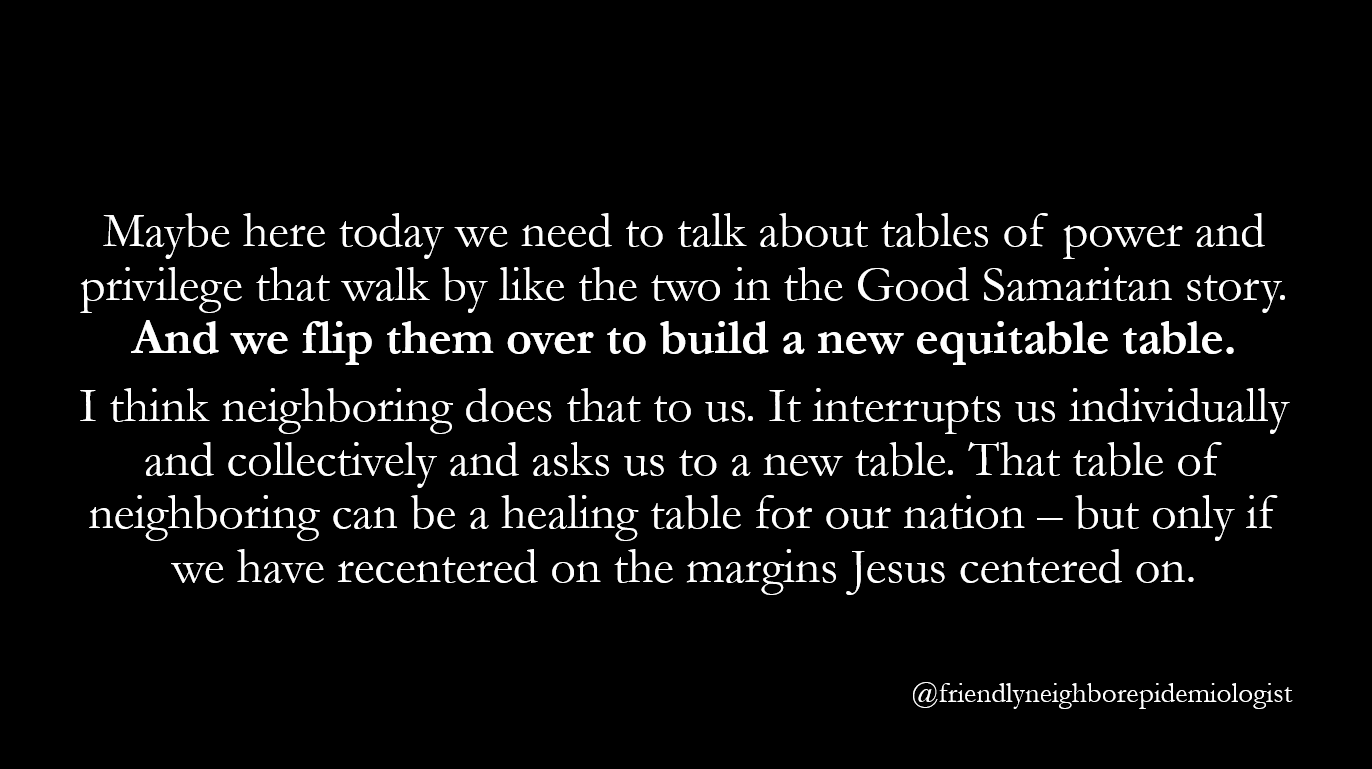
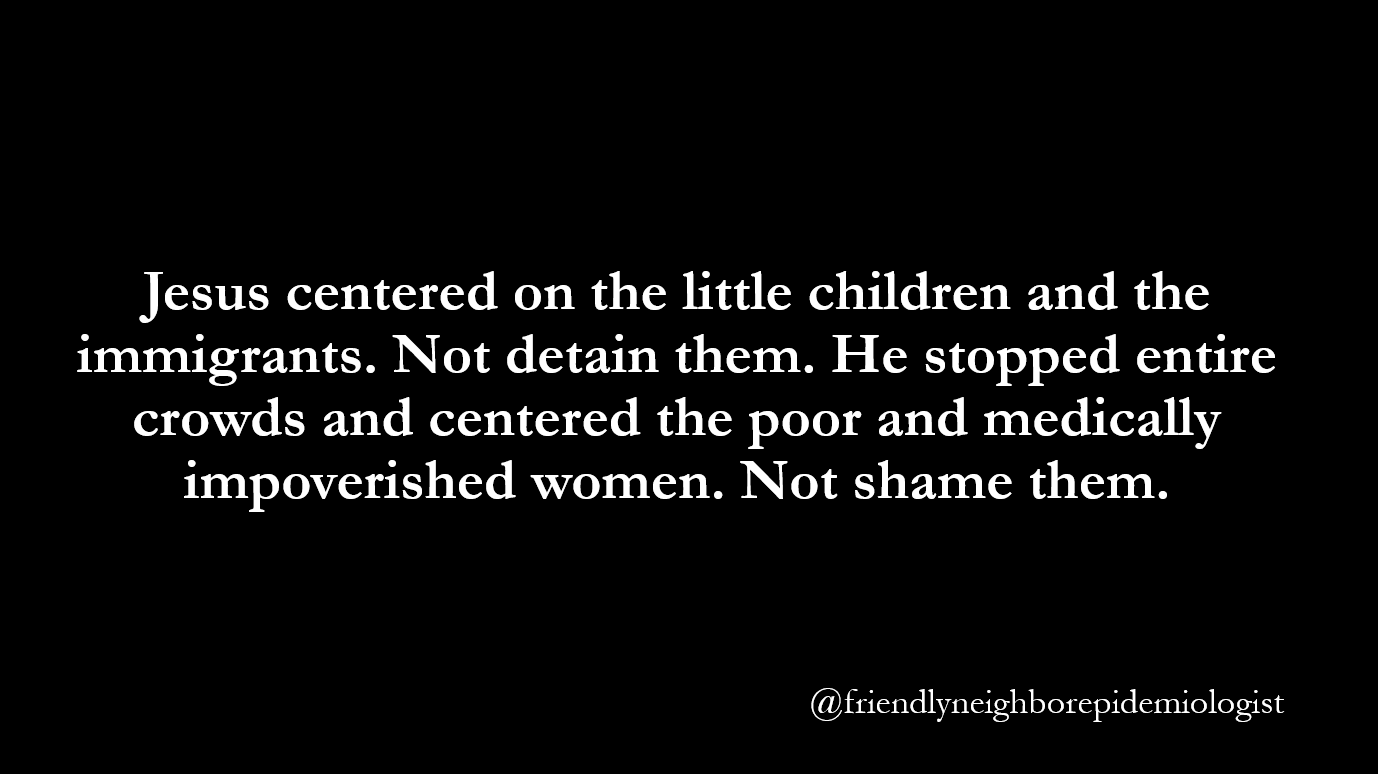
I think neighboring does that to us. It interrupts us individually and collectively and asks us to a new table. That table of neighboring can be a healing table for our nation – but only if we have recentered on the margins Jesus centered on. Jesus centered on the little children and the immigrants. Not detain them. He stopped entire crowds and centered the medically impoverished women. Not shame them.
This is a merciful table, a neighboring table that looks like heaven when the lowest person is at the head and where the marginalized have been brought to the center. When all have enough to eat, to share, and to be satisfied with extra baskets. A table of color and equality and children being able to read. This is a table of not just enough, but abundance. Where we ask for our daily bread and also for it to be multiplied for others. Not just for individuals but when our power structures, policies, and politics don’t walk by either.
A table where we recognize the sacredness in the other and makes us take off our shoes because the ground there is holy. That’s what a neighboring looks like to me.
I hope that when we are asked, “Who was the neighbor?”, we have lived out our faith in the margins, both the people and the structures, and we can answer with a resounding “It was me.”
Thanks so much for your courage to be in that room (and to use your powerful words). ❤️
Thank you so much Dr. Emily. Your words were powerful yesterday at the National Prayer Breakfast and I am so very proud of you for having the courage to speak in such surroundings. It feels very strange to speak of scary and National Prayer in the same paragraph. Perhaps someone there will be awoken by your words.